This Chinese AI Model is totally free and claims to outperform GPT 5
Discover how Chinese AI developer Moonshot AI’s new model Kimi K2 Thinking claims to outperform GPT-5 in key benchmarks, and what this means for the future of open-source AI.
TECHNOLOGY
Hafsa
11/10/20253 min read
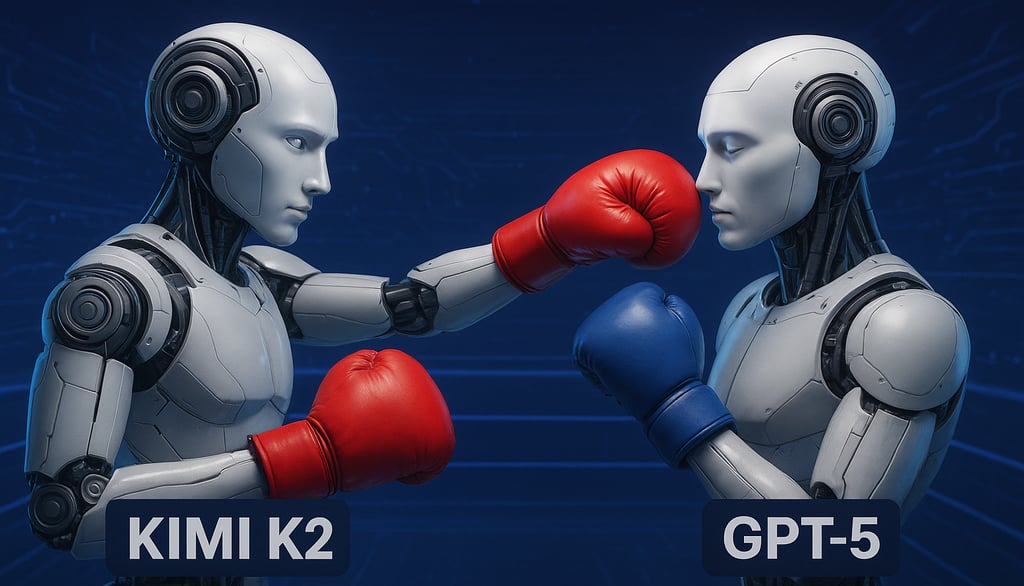
Chinese startup Moonshot AI has revealed its newest model, Kimi K2 Thinking, which is said to outperform OpenAI's GPT-5 in a number of performance metrics, in an unexpected development in the global race for artificial intelligence. This announcement is even more revolutionary because the model is entirely free and open-source, giving researchers and developers worldwide unrestricted access to state-of-the-art AI technology. The audacious assertion made by Moonshot AI establishes China as a significant competitor in the global AI market, where performance, innovation, and accessibility are becoming more and more intertwined.
Kimi K2 Thinking is a reasoning-focused model that was constructed using a Mixture-of-Experts (MoE) architecture. It is intended to manage tasks involving adaptive reasoning and complex, multi-step problems. Moonshot AI claims that it outperforms both GPT-5 and Claude Sonnet 4.5 on a number of common benchmarks, including Humanity's Last Exam, BrowseComp, and Seal-0. The company highlights that Kimi K2 Thinking has an advantage in tasks requiring critical thinking and real-time data integration because it can perform logical reasoning and use online tools in addition to producing human-like text. Furthermore, the model's training cost is estimated to be around US $4.6 million, which is significantly less than what large Western companies usually spend on comparable projects.
Moonshot's new model presents a compelling challenge, even though GPT-5 remains the gold standard in AI reasoning, creativity, and coding capabilities. If the claims are true, Kimi K2 Thinking might offer performance that is on par with or even surpasses that of closed models like ChatGPT Plus or enterprise-grade APIs, without the expensive subscription fees. By making advanced capabilities available to a wider audience, particularly startups, independent developers, and educational institutions that cannot afford pricey proprietary tools, this could drastically change the AI industry.
Kimi K2 Thinking's open-source and free nature is a significant step toward democratizing AI. Moonshot AI has opted for openness and transparency rather than limiting access through paywalls or licensing agreements. Global cooperation, experimentation, and adaptation are made possible by this strategy. Depending on the terms of the license, developers are free to modify the model, create applications, and even incorporate it into commercial systems. Additionally, it upends the conventional "pay-to-use" model that has long characterized the AI industry, creating new opportunities for innovation, particularly in areas with inadequate infrastructure or funding.
But before declaring victory over GPT-5, experts advise caution. The types of tasks being tested, evaluation techniques, and datasets can all affect benchmark results. To verify Moonshot's performance claims, independent validation will be required. Additionally, even though open-source models are strong, they might not have the enterprise-level documentation, support, and security that commercial solutions offer. Concerns about long-term dependability, data privacy, and regulatory compliance are still important factors to take into account, especially when implementing AI systems developed outside of Western regulatory frameworks.
The launch of Kimi K2 Thinking indicates a significant change in the global AI power dynamic despite these uncertainties. For the first time, a Chinese open-source model is claiming to perform better than the most sophisticated proprietary systems in the world at a significantly lower cost. This highlights how innovation is no longer limited to billion-dollar labs and challenges Western dominance in the AI space. Efficiency and accessibility are now just as important to the AI race as raw processing power.
This development presents exciting opportunities for researchers, developers, and entrepreneurs. Kimi K2 Thinking may provide an inexpensive basis for AI-powered goods, studies, or experimental instruments. It ushers in a new era of transparent cooperation in which financial limitations no longer restrict performance. Moonshot AI has garnered international attention and rekindled the discussion about the future of open-source artificial intelligence, regardless of whether it actually outperforms GPT-5.
Whether Kimi K2 Thinking fulfills its promise will become clear in the upcoming months. If it does, however, it might redefine what's feasible in the AI ecosystem through openness, cooperation, and innovation rather than exclusivity or cost. A free model that claims to outperform GPT-5 is more than just a headline in a world where access to AI is frequently expensive; it's a revolution in the making.
Insights
Explore the latest in tech and programming.
Contact
Blog
hello@neonbytes.online
© 2025. All rights reserved.